Published October 2020, mushstories Issue #5
1) “My living laughing love” (Anne Hathaway, p. 30)
When I was ten years old, my Ammoomma and I were at a Landmark bookstore in Chennai. Every Chennai trip of mine involved a repeating ritual of these ‘outings’ as Appooppa called them. The bookshop was the non-negotiable stop- the one for which I tolerated the clothes shops, the ‘knick-knack’ shops, and the occasional birthday-present-jewellery shop. That summer, Ammoo bought me the first six books in The Princess Diaries series. She didn’t check what the content was, she didn’t worry about what I may or may not be exposed to, I suspect she saw ‘Princess’ in the title, a cute illustration on the front, knew my reading was well up to the task, and bought the books. Which is how I found out what sex might be (my initial hypothesis from the somewhat subtle implications of the writing was, ‘if a girl and a boy see each other naked, she’ll get pregnant.’ This made me nervous).
Ammoo was an absolute force of nature. The kind that reminds you that softness is strength- like the quiet changing of tides, or how phototropic plants move.
2) “I learnt
the Stations of Bereavement,” (Mrs Lazarus, p. 49)
She passed away this May, at 86, in her small Chennai flat. Not in her own bed actually, but in the slightly larger bed that Appoo preferred (they didn’t always share a bed because he refused to sleep without the air-conditioner on and she was asthmatic). I was there with her. I got there four days before it happened and stayed till three days after. Ma couldn’t make it to Chennai from Mumbai because of lockdown restrictions at the time, despite trying for weeks. I’m an only child, Ma is an only child, Ammoo has one sibling who hasn’t travelled in years, none of our relatives in Chennai came over. It was a surreal experience. Humans aren’t built to grieve alone, I don’t think. So I didn’t. I just went straight into ops mode and did all the logistic-ing and sorting and packing and ‘informing’ and obituary-writing that needed to be done.
It’s been just over four months since then.
I know grief comes in waves. And like a macro-bit of clockwork, this one keeps coming.
It feels different from when Appoo passed. That was seven years ago now, I was already a baby adult and had a good chunk of responsibility in his home care and various ambulances and hospitals, but we got to process that together.
This newer grief began a week before Ammoo actually passed when she first told us she wasn’t doing so well, and the three of us were in three different cities. Hearing that the doctor had come and said, “Her pulse is weak,” sent me into a spiral one Thursday morning, exactly a week before it happened. It didn’t take long that day for it to come out in my journal entries that she was (is?) my favourite person in the world. Not just because of the relationship we shared, but also because of who she was.
3) “We met as students… BA. MA. PhD.” (Mrs Faust, p. 23)
Ammoomma was, by most definitions, a total badass. She came from a family of freedom fighters, she’d seen her parents be imprisoned, taken care of her sister during this time, travelled outside her village for high school and college, decided she wanted to study literature, got her ‘wedding money’ from her own grandmother to pay for her Masters, where she was the only woman on the course. She then moved to Tirupati to do her PhD after that (so she could teach at the college while writing her thesis) and met Appooppa, also a young teacher working towards his PhD, but in history. They were from different castes, different states, and different backgrounds. She was slightly older than him. They got married anyway. They spent their academic careers together- from earning their PhDs (she got hers first), spending a few years in Somalia on government deputation, raising their daughter, retiring as their respective Heads of Department, and then moving to a small flat in Chennai, continuing to stay engaged with their academic communities, and passing as much of this on to their only grandchild as they could.
4) “The midnight hour, the chattering stars…” (Queen Herod, p. 9)
For as long as I can remember, Ammoo and I have stayed up later than Appoo. We were the two who would be awake chatting. So much of what I know of the world comes from her- my Hindu grandmother who gifted me an Old Testament when I was a teenager. And so, I grew up, never having read ‘the canon’ of anything (two degrees later, I still haven’t) but having absorbed as much as possible from her.
Maybe more importantly though, through her, I developed an appreciation that ‘good literature’ isn’t the only way to enjoy the world. She consumed newspaper cartoons, South Indian serials, Khushwant Singh joke books, celebrity magazines, Agatha Christie, and Dan Brown with equal enthusiasm. Particularly for someone who grew up and grew old before the internet was commonplace, the breadth of her knowledge across subjects, and the depth of it, to almost always include trivia or some obscure detail, was astounding. We used to have a family joke that if she went on Kaun Banega Crorepati, we’d all be rich. Her father never policed what she read or knew of the world, and she never policed me.
5) “London Town, made for a girl and her double…” (The Kray Sisters, p. 63)
When I went to college in the UK, we stayed closed, we spoke a few times a week on the phone- I’d tell her what I was reading about, and she’d tell me what controversial tweet Shashi Tharoor had just posted (which of course she read about in the newspaper). She had been to London once in the 90s, but like me, and so many of us, had such a vivid imagination of it from all her reading.
In my first year of college, I visited a friend of Appoo and Ammoo’s in Kent, a retired historian called Prof. Antony Copley. I had visited him once with Ma on a previous trip to the UK. He was seriously unwell and we were discussing how best to donate his large collection of books on Indian history to the Sri Venkateswara University library in Tirupati. I still regret not having been able to sort that out for him. When I left, he gave me a copy of one of his books, ‘A Spiritual Bloomsbury: Hinduism and Homosexuality in the Lives and Writings of Edward Carpenter, E.M. Forster, and Christopher Isherwood’ (Lexington, 2006). Ma didn’t approve of this when I told her. Prof. Copley had always been described as ‘a bachelor’ within the family when I was younger. I later found out that he had been publishing on sexual morality since the 80s, and had a sodomy charge against him from the late 50s. I never discussed this with Ammoo, but it seems impossible that she wouldn’t have known what her academic friends were writing about. They were friends despite this. I don’t want to do an ‘oh she had a gay friend and that makes everything okay’ thing, but I felt more optimistic about eventually sharing my life with her, uncensored.
6) “I felt like this: Tongue of stone.” (The Devil’s Wife, p. 42)
When I moved back to Bangalore after my Masters a few years ago is when I began coming out for real (a never-ending process, of course). The years of fights with Ma over illicit boyfriends (there had been no girlfriends yet and thinking beyond the gender binary was not something my teenage self did, unfortunately), had never spilt over to Ammoo. Ma is a very private person, so she largely kept these things to herself. So, Ammoo hadn’t known about the boys in school, about the Scottish partner through and post-university, let alone knowing that I’m bisexual and polyamorous. Ma still doesn’t know this latter bit.
I so often thought about coming out to Ammoo. I actually thought I’d come out to Ammoo first. I felt like she would get it. (We had always been the pair, the more similar minds and personalities, her and me vs. Ma and Appoo, who were the ‘larger’, louder, more strong-willed pair.) Knowing about her deep affection for Prof. Copley contributed towards this. She always asked about him so sweetly, asked me if I could visit him more often than I did.
Instead, I visited Edinburgh every chance I got. In 2015, I watched Carol Ann Duffy performing at the Edinburgh Book Festival. I went up to her afterwards (I never do this, I truly hate doing it) and asked for an autograph on a fresh copy of The World’s Wife, told her my grandmother in India was a professor and huge fan and got her to sign, “Dear Radhamani…”
A couple of years after I moved back, Ammoo was asked to speak at a conference at her old university. A keynote address, at the age of 85. She threw herself into it, decided to write about Carol Ann Duffy and The World’s Wife. In Ammoo’s own words (from the paper delivered which I typed out later for the conference publication), Carol Ann Duffy didn’t succeed Ted Hughes as the British Poet Laureate because,
“Tony Blair, the then Prime Minister of Britain had reservations as he was afraid of severe repercussions if she was appointed, the bitter comments by the spiteful British tabloids, in particular, all because of her unconventional attitudes towards personal morality. She was a self-acknowledged lesbian and continues to be so. She has scant regard for conventional morals, insisted on by religion or society.”
Transcribing these words of hers, from her handwriting onto my screen in 2019, was an extra push to come out. Ammoo wasn’t just incredibly open-minded and friends with Prof. Copley, she also didn’t mind Carol Ann Duffy’s “scant regard” for convention. I should tell her, right?
But I didn’t.
7) “And this is my lover, I said” (Mrs Tiresias, p. 17)
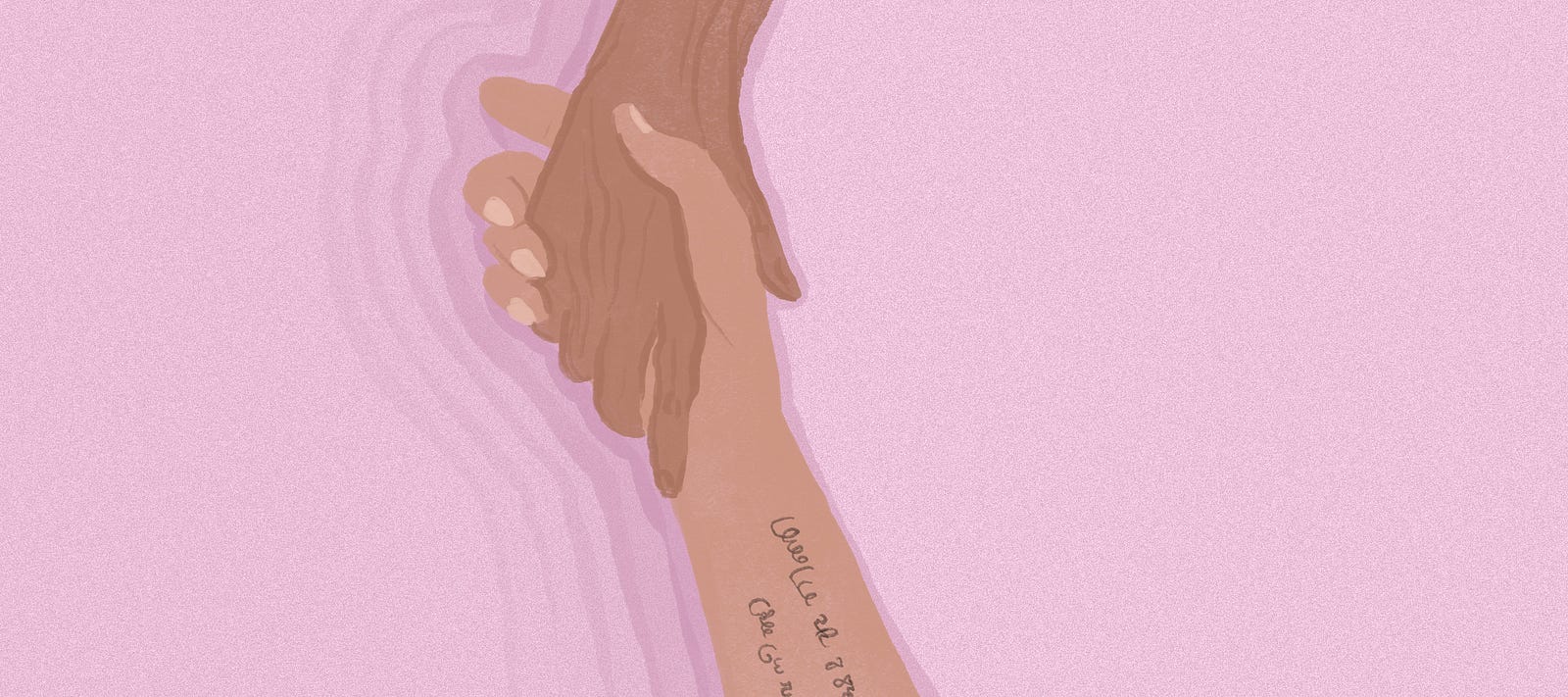
For a month in 2019, Ammoo lived with me in Bangalore. That month, I got the tattoo I’d been intending to get for years. It’s two lines from a poem Valliappooppa (Ammoo’s father) wrote, in Ammoo’s handwriting. I’d asked her to write it down for me (and translate it because I don’t read Malayalam) many times and she finally sent it to me in Malayalam and English on my birthday in 2018. She didn’t know what I intended to do with it and I was nervous about how she’d react, but when I came home, she loved it. She wasn’t ever entirely convinced that it was permanent, no matter how many times I said it was, but she loved it. For me, I don’t just love what it means, it also feels like a bit of home and legacy.
Otherwise, my life didn’t stop that month, it just meant I had to be mindful of being home before she slept (but we know she’s a late sleeper!) or telling her in advance that I’d be out. It also meant that my girlfriend, A, stayed over at mine more than usual. Which also meant that she and Ammoo met. Not once, but on a few occasions. Ammoo has sat at the dining table with us while we have dinner. She’s sat with us as we have breakfast before work.
There was one day, we were leaving the house and went to say bye to Ammoo, and Ammoo kissed A’s forehead. I am still filled with a warmth every time I think of it.
Now that warmth is tinged with the cool edges of a regret though.
I still didn’t tell her. She thought A was ‘just a friend’ who was staying over because our homes and offices weren’t too far apart so it was convenient. A is the only partner of mine that Ammoo has ever met. I’m grateful and I’m torn.
8) “It was a place where language stopped,
a black full stop, a black hole…” (Eurydice, p. 58)
Those last few days this year, I sat with Ammoo in bed, holding her hand while she tossed and turned in her sleep. I still didn’t say anything. Her tests were all looking largely okay, we thought she’d get better. I thought I would get to tell her. I didn’t want to say it, whispered, under my breath, when I didn’t know how much she was hearing or processing, because that would have felt even more final. So I didn’t tell her.
Now, I’m left with signs that give me hope for what could have been and her handwriting tattooed onto my arm.
9) “Samaradi Thrishnakal Aakavey Neengi/
Samathayum Shanthiyum Kshemavum”
(Wiping off the tendency to promote wars/
establishing equality, peace and prosperity)
*Section headings 1–8 are excerpts from poems in The World’s Wife collection by Carol Ann Duffy, Picador, 2000; Section 9’s heading is an excerpt from the poem Upasana (aka. Akhilanda Mandalam) by Pandalam K. P., translated by Dr M. Radhamani
Illustration by Veer Misra, http://mushstories.substack.com/p/issue-5
 Megha Harish